

Fraud in Makhana Business: Common Scams and How Buyers Can Stay Safe
Fraud in makhana business is one of the biggest risks that new buyers and traders face when entering this industry. Payment scams, fake suppliers, and price disputes are becoming increasingly common, especially for those who are new to the makhana trade.
Sorry, sir, we can’t pay in advance. We will pay right after receiving the stock.”
“भैया एडवांस नहीं कर पाएंगे, माल भेज दो, माल उतरते ही पेमेंट कर देंगे।”
These statements are extremely common in the makhana business. Almost every supplier hears this from new buyers.
If you are a buyer, you may think the same way. You might be worried about paying in advance because you fear that after payment, the supplier may not dispatch your stock. This concern is genuine. However, there is also a very common pattern of fraud in makhana business that every buyer must understand.
In this article, you will learn:
- Why advance payment required in makhana trade.
- The most common fraud in makhana business
- How to protect yourself from payment scams
Why Suppliers Ask for Advance Payment
Before understanding fraud in makhana business, it is important to understand the basic structure of trade.
Makhana prices are highly unstable. Prices can increase or decrease quickly depending on the season and demand. When a supplier confirms an order, he usually:
- Blocks stock for you
- Processes grading and packing
- Arranges dispatch
This requires financial commitment.
Supplier’s Risk Without Advance
Suppose a supplier confirms your order at ₹1000/kg.
If the market price drops to ₹800/kg, some buyers cancel their orders or renegotiate the price.
This results in a significant loss for the supplier.
To avoid this, suppliers ask for advance payment, especially from new buyers. Advance ensures that the buyer is serious and the supplier can prepare stock without risk.
Most Common Fraud in Makhana Business
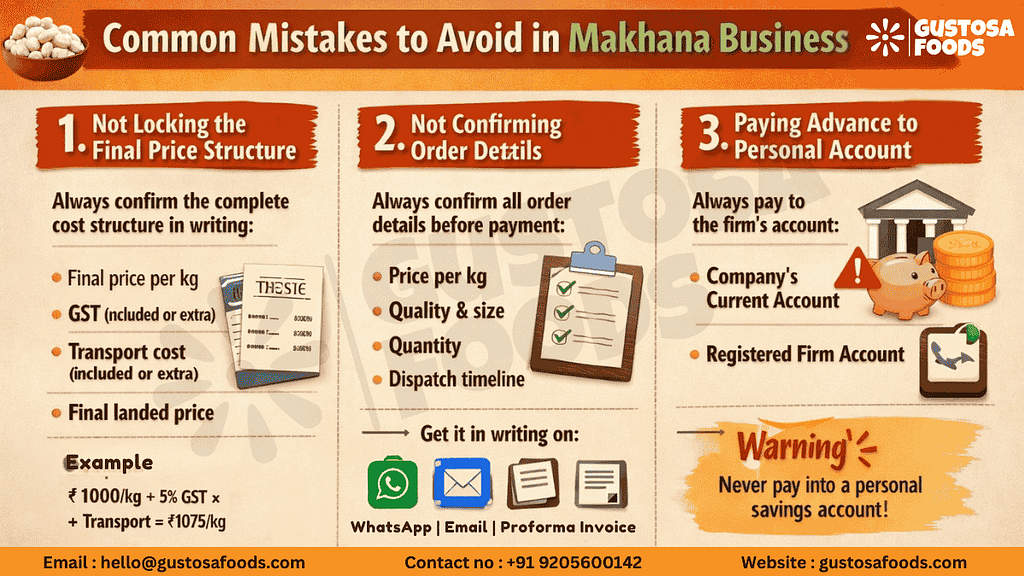
1. Not Locking the Final Price Structure Properly
Another common cause of dispute and fraud in makhana business is not locking the complete price structure clearly at the time of deal confirmation.
Many buyers confirm only the basic rate per kg, but forget to confirm important cost components such as
- GST
- Transportation
- Packaging or loading charges
Later, when the final invoice is generated, buyers realize that GST and transport were not included in the quoted rate. This suddenly increases the landed cost and creates conflict between buyer and supplier. In many cases, this confusion is labelled as fraud, even though it is actually poor communication from both sides.
Example of Actual Landed Cost (Real Scenario)
If the material price is ₹1000/kg:
- 5% GST = ₹50/kg
- Approx transport = ₹25/kg
Final landed price = ₹1075/kg
This ₹75/kg difference may look small, but in bulk orders it becomes huge. Such gaps often lead to disputes, cancellations, and sometimes accusations of fraud in makhana business.
How to Avoid This Mistake
Whenever you confirm a deal, always lock the complete structure clearly:
- Final price per kg
- Quality and size
- Quantity
- GST (included or extra)
- Transport cost (included or extra)
- Final landed price
Always confirm these details in writing on:
Clear written confirmation protects both buyer and supplier and prevents misunderstandings that often turn into fraud disputes.
2. Not Confirming Order Details Properly
Always confirm all order details before making any payment:
- Price per kg
- Quality and size
- Quantity
- Dispatch timeline
Best Practice
Confirm everything in written format:
- WhatsApp (most common in real trade)
- Email (more professional)
- Proforma invoice or quotation
Today, WhatsApp is widely used in business because it is fast and accessible. Always keep written proof of the deal. This protects you from fraud and misunderstandings.
3. Paying Advance to Personal Savings Account
This is the biggest mistake buyers make and one of the most common causes of fraud in makhana business.
Many unregistered brokers or fraudsters:
- Offer very low prices
- Ask for an advance in your personal account
- Disappear after receiving payment
Safety Rule
Never pay an advance into a personal savings account.
Always transfer payment to:
- The company’s current account
- Registered firm account
If someone insists on personal account payment, treat it as a warning sign.
Is Company Account Payment Fully Safe?
Even paying to a company or firm account does not guarantee 100% safety. You must still verify:
- Whether the firm is genuine
- Business location
- Market reputation
- Past transaction history
Fraud in makhana business can still happen if proper verification is not done.
Final Advice for Buyers
Advance payment is a normal part of genuine makhana trade.
Fraud usually happens when buyers:
- Chase unrealistically low prices
- Trust unknown brokers blindly
- Pay without verification
Fraud in makhana business can be avoided if buyers follow proper verification and payment discipline. Smart buyers who understand fraud in makhana business always deal with verified suppliers and clear written agreements.
In the next tutorial, we will explain how to identify genuine suppliers and verify them before making an advance payment.
Follow for real makhana business insights, or contact us at hello@gustosafoods.com or +91 9205600140 for genuine deals.
Frequently Asked Questions
Why do makhana suppliers ask for advance payment?
Makhana prices change frequently, and suppliers must block stock, process grading, and arrange dispatch. An advance payment confirms that the buyer is serious and reduces supplier risk.
Is an advance payment normal in the makhana business?
Yes. Advance payment is a standard practice in genuine makhana trade, especially when dealing with new buyers or large bulk orders.
Is paying to a company account fully safe?
No. Even company account payments are not 100% safe. Buyers must verify the firm’s reputation, business location, and past transactions before paying.
How to identify genuine suppliers and avoid fraud in makhana business?
Check GST details, business location, reputation, and always confirm the final price structure before payment.
How can buyers avoid fraud in makhana business?
Buyers can avoid fraud in makhana business by verifying suppliers, confirming order details in writing, and paying only to company accounts.
What is the biggest cause of fraud in makhana business?
The biggest cause of fraud in makhana business is paying advance to unknown traders or personal savings accounts.